

An AI tool instead of a pay rise?
English edition. The weekly letter itself is sent by email in French.
At a large car-industry group, employees put an AI that helps them in their work on a par with a 3% pay rise. Also this week: for 66% of the members of ANDRH, the French association of HR directors, AI is the top issue of the next presidential term; 85% of US physicians use AI every week; and at our clients, a user now sends 169 messages a month to AI, a record.
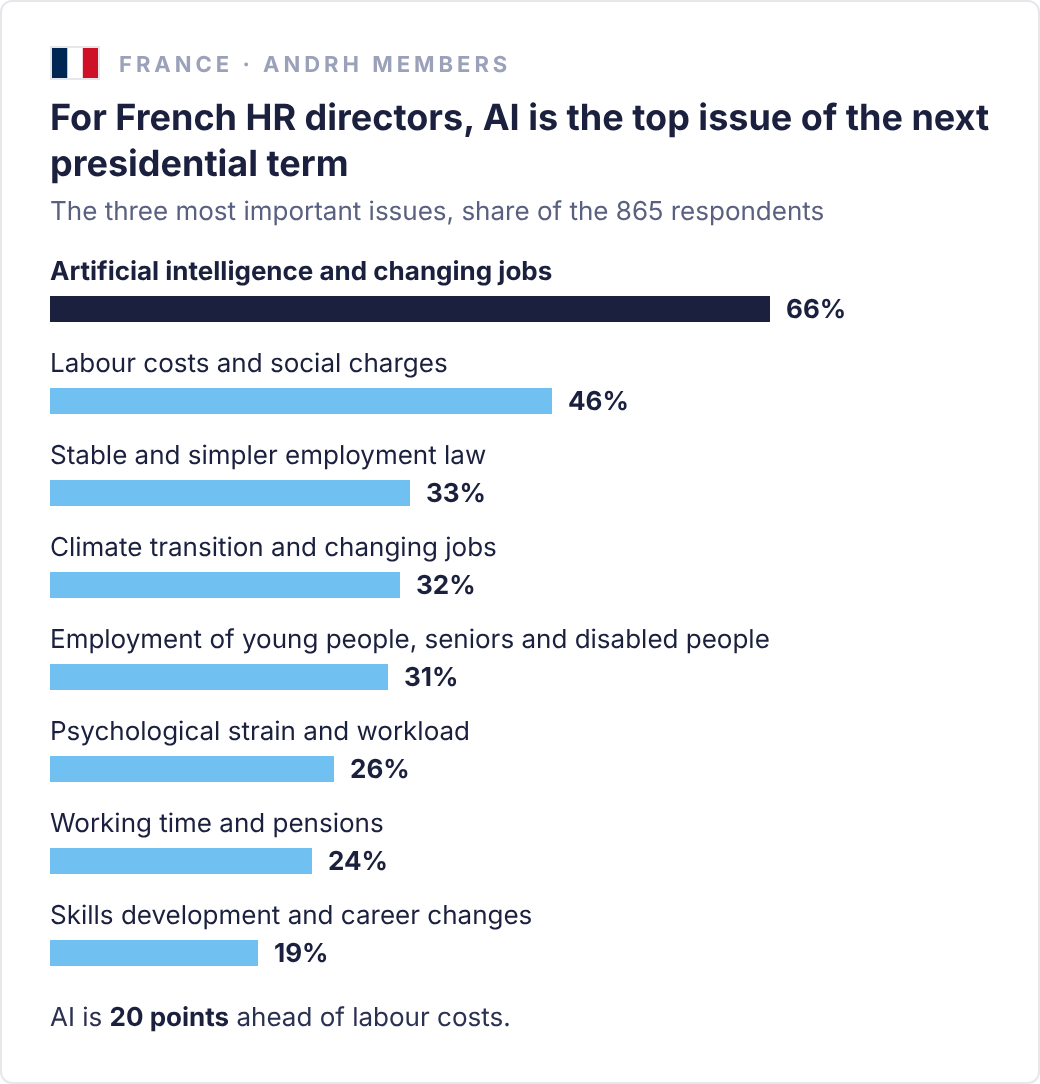
AI is the top concern of French HR directors for the next presidential term
ANDRH, the French national association of HR directors, surveyed its members ahead of the 2027 presidential election. Of 865 respondents, 81% of them working HR professionals, 66% put artificial intelligence and changing jobs among the three most important issues of the next presidential term. That is far ahead of labour costs (46%) and the stability of employment law (33%).
Their expectations are specific. Asked to choose two priorities for employment and skills, 53% pick better support for the impact of AI on jobs: identifying the skills that are becoming obsolete or critical, and making sure employees stay employable. Next come funding career changes towards jobs facing shortages (35%) and a policy based on skills (33%). 83% want career paths that anticipate changes of job rather than suffer them.
For HR, AI is not limited to the training plans they build for other employees: it also changes the work of their own department. And here, they are moving slowly. According to the 3rd OpinionWay barometer for Kelio, carried out in February and March among 306 HR managers, 33% use AI in their work, up from 9% in 2024. 29% have no plans in this area, and 53% do not trust it to produce quality work. The top barrier cited: data confidentiality (39%).
Sources: ANDRH, “Présidentielle 2027” member survey, press conference of 12 November 2026; online questionnaire and meetings with member groups, 6 September to 7 October 2026; 865 respondents, including 81% working HR professionals and 53% in companies with fewer than 300 employees; not representative. Self-reported. Reliability: B. · Kelio and OpinionWay, 3rd barometer of AI in HR, 26 March 2026; 306 HR managers at private companies with 20 or more employees, by telephone, 16 February to 11 March 2026 (and 1,071 representative French people). Self-reported. Reliability: B.
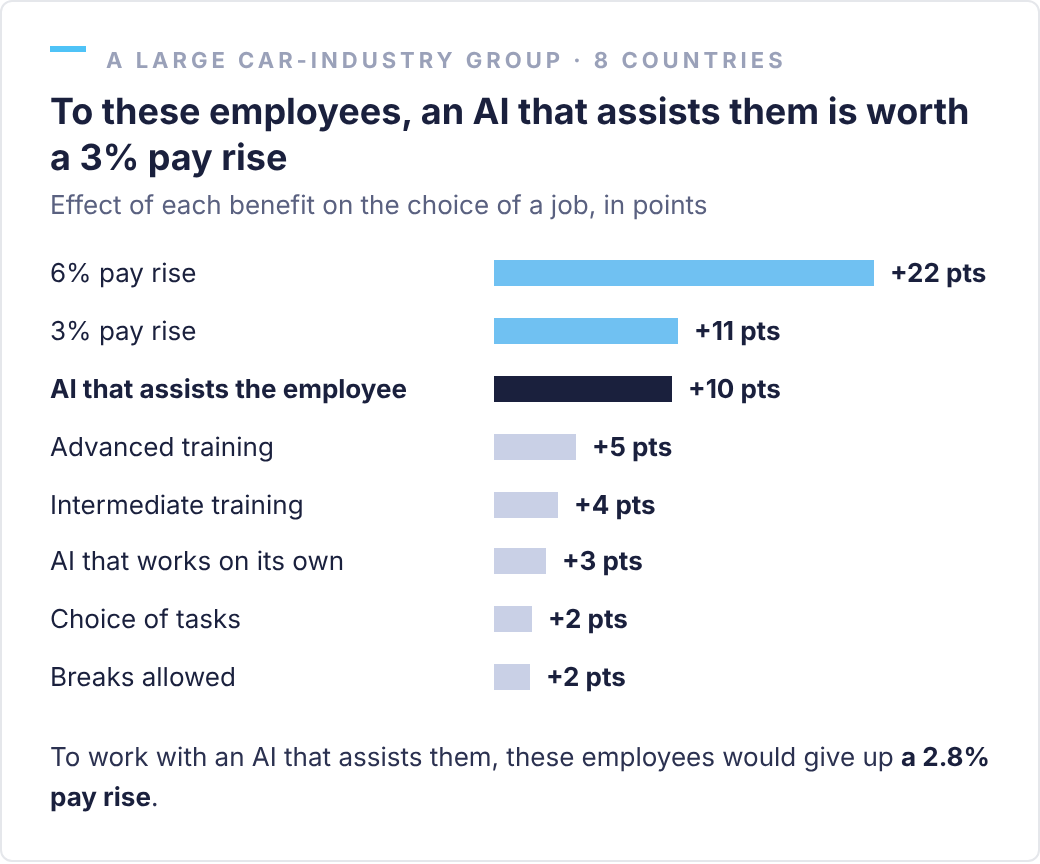
For employees of a large car-industry group, an AI that assists them is worth a 3% pay rise
What do employees prefer: a pay rise, or a good AI tool? Economists at Maastricht University put the question to 423 employees of a large car-industry group, whose name is not published, in eight countries. Their job: checking the quality of electronic components on a screen. Each chose six times between two job offers that differed on AI, breaks, training, choice of tasks and pay.
Pay matters most: a 6% rise increases the probability of choosing a job by 22 points, a 3% rise by 11 points. But an AI that assists them, alerting them when it disagrees with them, does almost as well: +10 points. These employees put an AI that helps them on a par with a 3% pay rise: they would give up a 2.8% rise to have it. An AI that handles the easy cases on its own is worth only 0.7%.
Women, 80% of respondents, seem slightly less drawn to this AI (4 points less than men); over-50s no less than younger workers. But these gaps are not statistically significant.
This is what we argued in our op-ed “Master AI to be employable, offer AI to be attractive”: a good AI tool is part of what an employer offers, like training, if it helps rather than replaces.
Source: L. Fleck, M.-C. Fregin, A. de Grip and S. Steens (Maastricht University), “AI Implementation at Work: Worker Preferences for Task Changes”, IZA Discussion Paper 19076, November 2026; choices between hypothetical job offers, 423 quality control employees at a multinational manufacturing group in the automotive industry, eight countries, 4,992 choices; effects estimated by the authors (table 3). Working paper, not peer reviewed. Stated preferences. Reliability: B+.
85% of US physicians use AI in their work at least once a week, up from 51% a year earlier, according to Doximity's annual report (3,379 physicians surveyed in September 2026). 52% use it every day. The rise is at least 34 points in every age group. Oncology leads: more than 93% of oncologists use AI every week, 65% every day; pathology and anaesthesiology trail, at around 70%. 41% of oncologists and 38% of general surgeons think it could save them more than six hours of administrative work a week, against 23% of family physicians. Top uses: literature search (70%) and clinical decision support (63%, up from 37% a year earlier). The downside: 61% are worried about trainees' training.
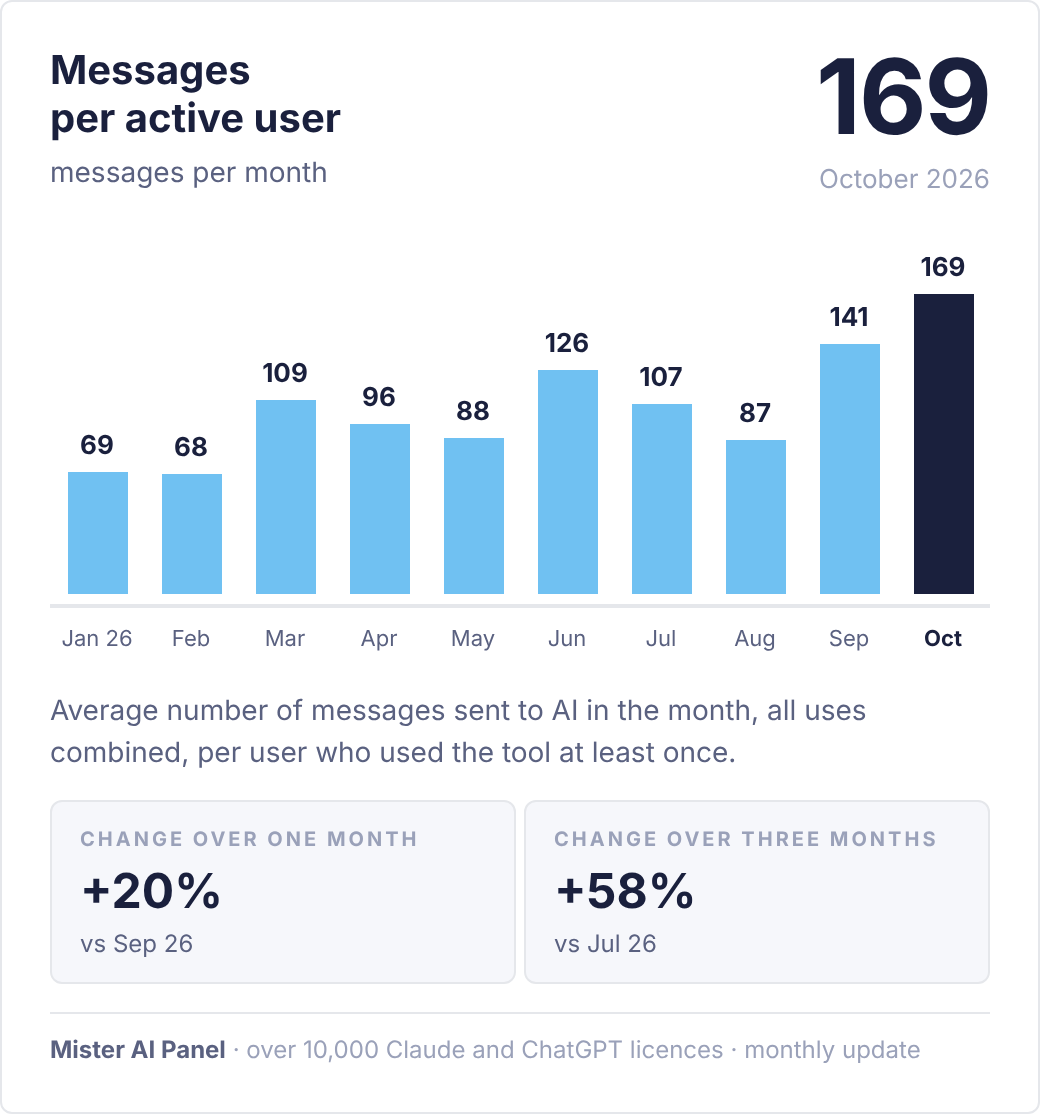
169 messages per active user in October: AI use is speeding up
This is the indicator we follow most closely: the average number of messages sent to AI each month per active user, across the more than 10,000 Claude and ChatGPT licences Mister AI manages for its clients. In October it reached 169 messages, its highest level of the year: 20% more than in September (141) and 58% more than in July.
Last winter, the counter topped out at 69 messages a month; in spring, it hovered around 100. An active user now sends nearly two and a half times as many messages as in January.
The average hides wide gaps. Across the 250 companies tracked from May to October, the 10% most active users send 46.5% of messages, the 20% most active 65%. It takes about 340 messages a month, more than fifteen per working day, to be in that top 10%. This is not down to a few companies: in the median company, the 10% most active also account for 46% of messages.
Good news: the rise does not come only from the champions. In companies with at least 20 active users, between September and October, the 10% most active went from 531 to 639 messages a month (+20%), the remaining 90% from 71 to 87 (+23%). For an HR director, that is the challenge: bringing those 90% closer to the practices of the leaders. All these figures are measured, not estimated.
Source: Mister AI Panel, monthly indicators, over 10,000 Claude and ChatGPT licences managed by Mister AI; measured usage data, October 2026; average per active chat user (152 when users of Cowork only are also counted); concentration measured across 250 companies, May to October 2026; raw figures, no holiday adjustment. Measured.
- 01For two French HR directors in three, AI and changing jobs are the top issue of the next presidential term, far ahead of labour costs.
- 02For employees of a large car-industry group, working with an AI that assists them is worth a 3% pay rise; an AI that does the work in their place is worth almost nothing to them.
- 03In October, an active user sent 169 messages to AI, nearly two and a half times as many as in January; the 10% most active account for almost half of all messages.
Get the weekly letter
Every week: the data signals that matter, the number of the week, and what we measure among our clients. Free, no advertising. The letter is sent in French; every issue is also published in English on this site.
One letter a week, on Sunday, written in French. Unsubscribe in one click, at any time.