

Where have the job ads gone?
English edition. The weekly letter itself is sent by email in French.
In the third quarter of 2026, about 25,000 job ads were missing from France Travail, the French public employment service, in the occupations most exposed to AI: sales, accounting, human resources, IT. Also this week: the jobs where AI training helps you get hired; what AI changes in employees' working day; and 7% of marketing teams are already AI agents.
About 25,000 job ads are missing in the occupations most exposed to AI
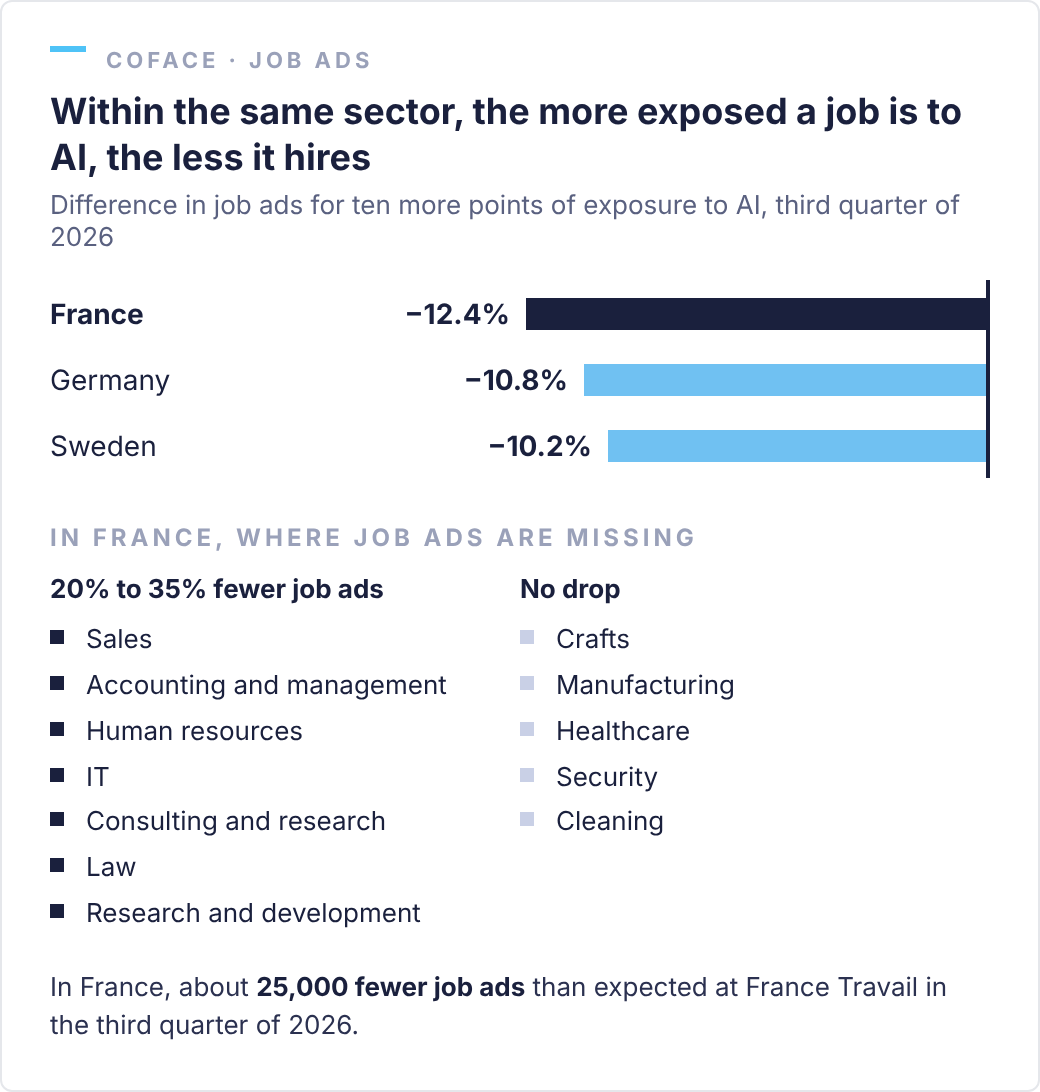
The credit insurer Coface and the Observatory of threatened and emerging jobs have built an indicator to track the effect of AI on hiring. Since the launch of ChatGPT, it compares the job ads posted with France Travail, the French public employment service, in occupations more or less exposed to AI, depending on the share of their tasks AI can do, within the same sector. In the third quarter of 2026, about 25,000 ads were missing compared with what could be expected, or more than 100,000 over a year.
The link is consistent: within the same sector, ten more points of exposure to AI go hand in hand with 12.4% fewer job ads. The gap appears in the summer of 2023 and has widened since. It is slightly larger in France than in Germany (10.8%) and Sweden (10.2%).
Office jobs are the ones hiring less: sales, accounting and management, human resources, IT, consulting and research, law, research and development. Their job ads are 20% to 35% below the expected level. Crafts, manufacturing, healthcare, security and cleaning show no drop. And every level of experience is affected, from beginners (14% fewer ads) to profiles with more than four years (16%).
For an HR director, the effect of AI does not come first through layoffs, but through hires that do not happen: a departing employee is not replaced, a recruitment is postponed. It shows up in the hiring plan before it shows up in headcount.
Source: Coface and Observatoire des emplois menacés et émergents (A. Duthoit, A. Arquié), “IA et emploi : quatre ans après le lancement de ChatGPT, les recrutements ralentissent davantage dans les métiers les plus exposés” (AI and jobs: four years after ChatGPT, hiring slows more in the most exposed occupations), 17 November 2026; AI-LERT indicator, job ads registered with France Travail, base third quarter of 2022, comparison within the same sector between occupations more or less exposed to AI; statistical link, without proof of a direct causal link; the 25,000 figure comes from Coface's press release. Measured. Reliability: B.
The jobs where AI training helps you get hired
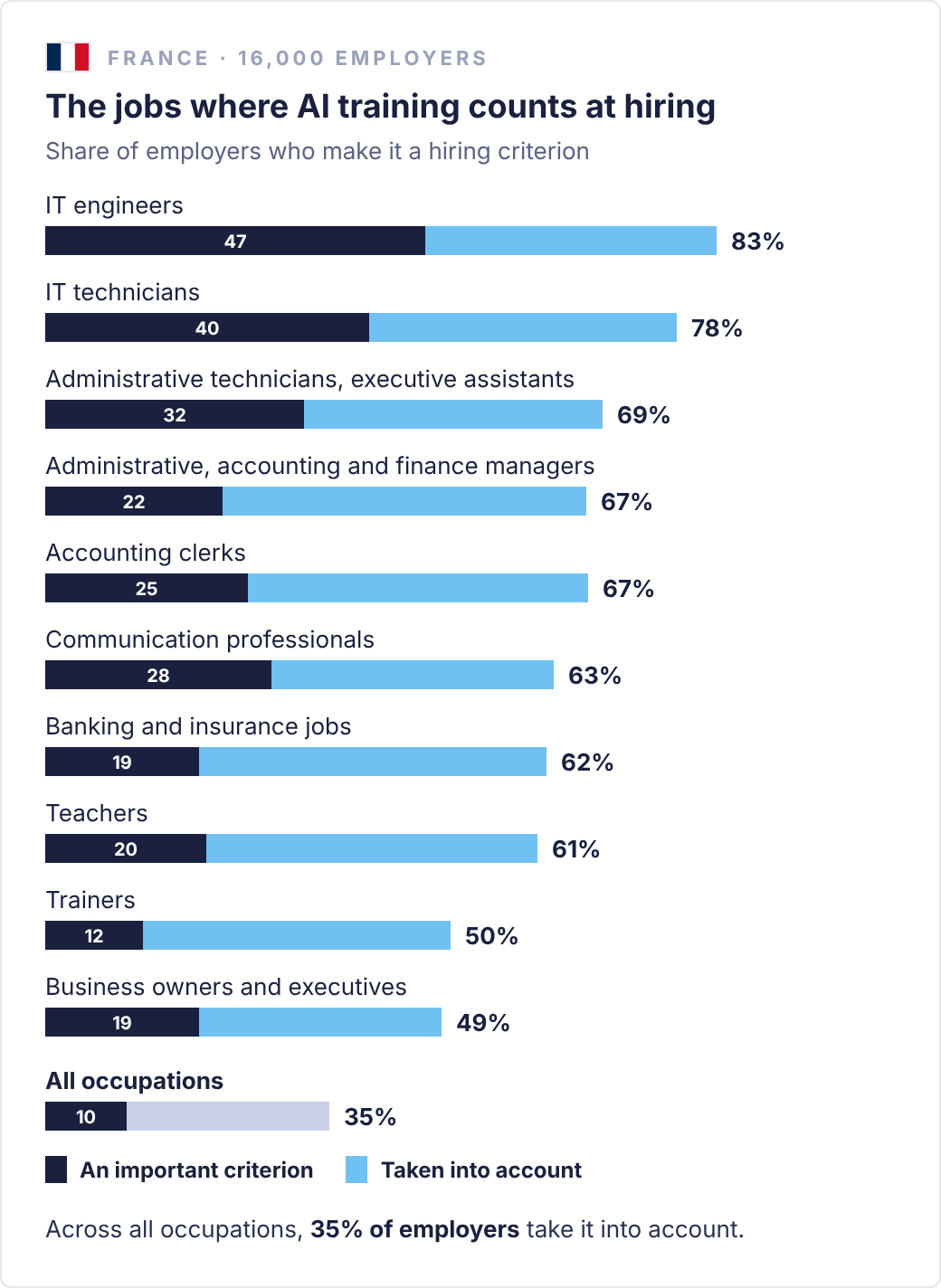
France Travail, the French public employment service, surveyed more than 16,000 employer establishments in its 2026 Labour Needs survey. 38% already use or test AI, and 71% of those with 200 employees or more. For the occupation they hire most for, 35% of employers take into account whether a candidate is already trained in AI, and 10% make it an important criterion.
The gaps between occupations are wide. IT engineers come first (83%, including 47% for whom it is an important criterion), ahead of IT technicians (78%). But the criterion also counts far from tech: 69% for administrative technicians and executive assistants, 67% for administrative, accounting and finance managers as for accounting clerks, 63% in communication. For trainers, it is 50%.
Demand is moving faster than training. Among establishments that use AI, 70% say their employees will need to know how to use generative AI within three years. Yet only 22% have already trained them, and 45% have nothing planned, 49% in establishments with fewer than 5 employees.
For an HR director or a head of learning and development, the message is twofold: training teams in AI makes them more employable, and a candidate who is already trained now has an edge in office jobs, not only in IT.
Source: France Travail (G. Blache and F. Lainé, Labour Market Observatory), “L'intelligence artificielle dans les entreprises et les métiers : recours à l'IA, compétences demandées et formation” (AI in companies and occupations: use of AI, skills required and training), Éclairages et synthèses no. 90, November 2026; supplementary 2026 Labour Needs (BMO) survey, by telephone, AI module with just over 16,000 establishments with at least one employee; question asked about the establishment's main occupation. Self-reported. Reliability: A-.
AI agents already make up 7% of marketing teams, according to some sixty chief marketing officers of large companies surveyed by BCG and the MMA Global alliance between May and July 2026. They expect 27% within two to three years, nearly four times as much. The agents' share would come out of every other category: within two to three years, employees would fall from 57% to 48% of the team, agencies from 25% to 16%, freelancers from 8% to 5%. 64% of chief marketing officers say transforming marketing with AI is now a bigger part of their job, and BCG stresses that knowing how to manage these agents is becoming a key skill for the in-house team.
With AI, less time searching and writing, as much time in meetings
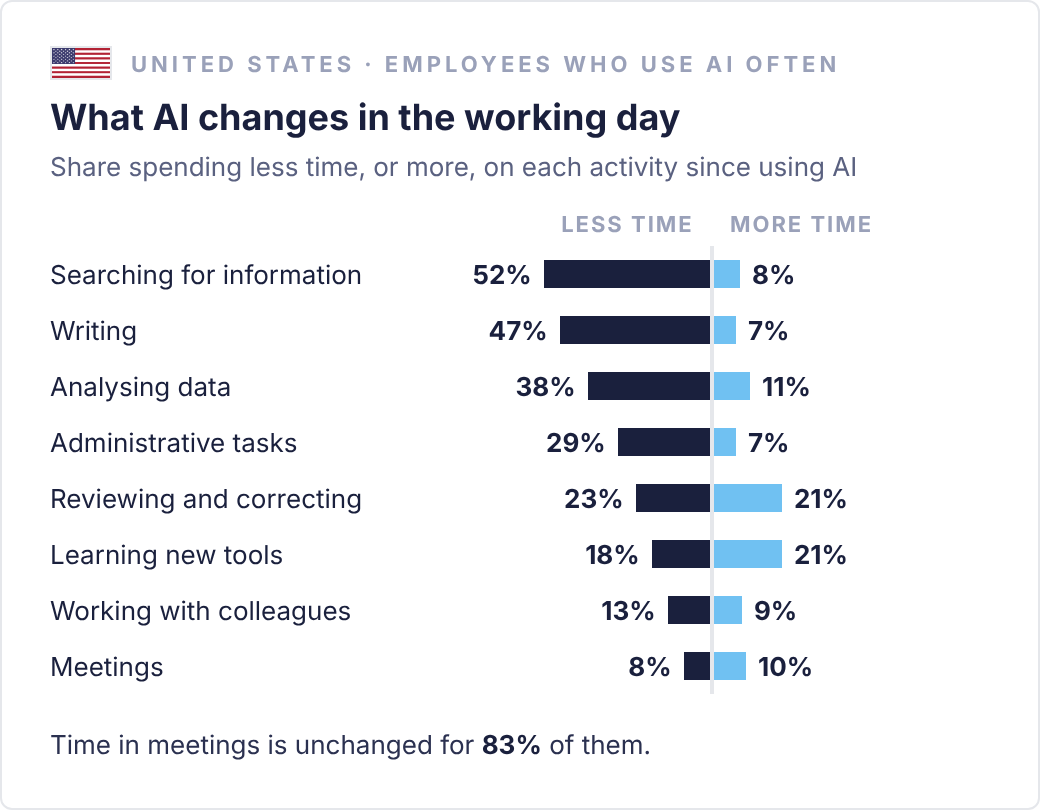
In August, Gallup asked 21,648 US employees how AI has changed their schedule. 32% use it at least a few times a week, and 16% every day. Among these regular users, 88% say AI has changed the way they split their time.
What shrinks are the tasks AI can do: 52% spend less time searching for and gathering information, 47% writing, 38% analysing data, 29% on administrative tasks. What grows is checking: 21% spend more time reviewing and correcting, as many learning new tools.
Time spent with other people does not move: it is unchanged for 83% of regular users in meetings, 82% with clients, 78% with colleagues. Mental effort also stays the same for 65% of them. And expectations are not yet running away: 36% say more is expected of them each day.
For an HR director, the typical working day is shifting: fewer first drafts, more checking and more relationships. These are the skills, reviewing work done with AI, adapting it to the context, working with others, that now need to be hired and trained.
Source: Gallup (A. Kemp), “How AI Is Changing the Way Employees Spend Time at Work”, 16 November 2026; quarterly survey, 21,648 US employees, 5 to 19 August 2026, probability panel, online, margin of error ±0.9 points; time questions asked of frequent users (at least a few times a week). Self-reported. Reliability: A-.
- 01In the office jobs most exposed to AI, about 25,000 job ads are missing per quarter: AI shows up first in the hires that do not happen.
- 02For 35% of employers, AI training counts at hiring, up to 83% for IT engineers; but 45% of companies that use AI have no training planned.
- 03Among employees who use AI often, time spent searching and writing shrinks; time spent reviewing, learning and with other people stays the same or grows.
Get the weekly letter
Every week: the data signals that matter, the number of the week, and what we measure among our clients. Free, no advertising. The letter is sent in French; every issue is also published in English on this site.
One letter a week, on Sunday, written in French. Unsubscribe in one click, at any time.